Repair
Pool leak detection and repair in Houston
Pressure, dye and acoustic tests, then a detailed report on cause, scope and repair options.
Chapter 01
A pool that loses more than it evaporates
Every Houston pool loses water in summer. Sun, wind and a hot deck pull an inch or more off the surface in a dry week, and that alone sends owners to the hose. The question is whether the pool is losing more than evaporation explains. A bucket test answers it: set a weighted bucket of water on the first step, mark the water level inside it and the pool, and compare after a day. If the pool drops further than the bucket, water is leaving through a crack, a fitting or a buried line.
Where it leaves matters. Leaks hide at the skimmer throat, around the light niche, at return fittings, in the spa spillway, in a cracked shell, or underground in the suction and return plumbing between the equipment pad and the water. Clay that shifts under a deck pulls on every one of those joints, which is why the same pool can develop a second leak a few years after the first.
Guessing is the costly part. Patching a visible crack while the real loss is a buried return line means paying twice and still topping up the pool.
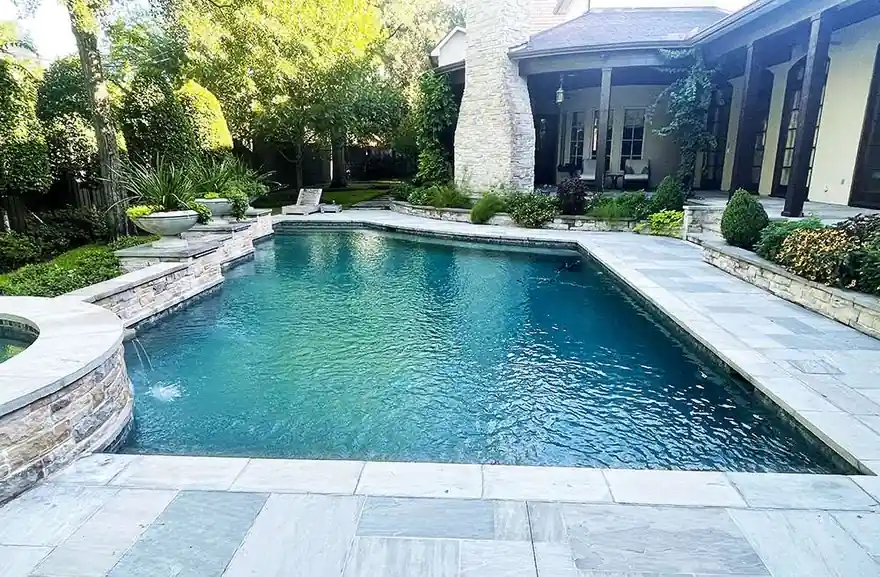
Rectangular pool with a stacked-stone wall and scupper spouts
Pressure, dye and acoustic tests
A proper leak inspection runs three kinds of test, because each one rules out a different place. Pressure testing isolates the suction and return lines one at a time: each line is plugged, pressurised and watched, and a line that will not hold pressure is the one losing water. Dye testing puts a drop of dye near a suspect crack, fitting or niche with the pump off, and the dye is drawn straight into the leak if there is one. Acoustic testing uses a sensitive listening device to hear the faint hiss of water escaping from a pressurised pipe or a shell defect.
Each inspection includes a detailed report on the cause, the scope and the repair options. You get what was found, where, why it likely happened and what each way of fixing it involves, so the decision is yours and it rests on evidence. Sutton Pools has been diagnosing Houston pools since 2007, and the report is where that diagnosis ends up in writing.
Call (281) 789-4584 to book a leak inspection anywhere in Houston, The Woodlands, Katy or Galveston.
Chapter 03
Fixing the right thing, once
With the leak located, the repair is matched to it. A failed fitting or skimmer throat is resealed or replaced. A cracked line is re-run or sleeved. A crack in the shell is opened up, cleaned and repaired, then sealed so water does not find the same path again. The report lays out the options so you can see the difference between a quick fix and a lasting one.
Skipping the repair has a cost that builds quietly. Escaping water carries soil with it, and soil that leaves from under a shell or a deck leaves a void. Decks settle, coping lifts, plumbing loses its support, and a leak that began as a loose fitting becomes a leveling job. Pumps running on a low pool can also draw air and burn out.
Watch for the signs of another leak: the auto-fill valve clicking on more often, a soft or soggy patch in the yard, tile that shows a fresh waterline step lower than before, or a pool that needs chemicals more than usual because it keeps taking in fresh water. Any of those is a reason to call again.
Sutton Pools has served Houston pools since 2007, and every leak inspection ends with a written report. Call (281) 789-4584.