What Houston clay and heat do to pool tile, coping and decks
The edge of your pool is where soil movement, sun and water chemistry all meet, and it is usually the first place trouble shows.
October 27, 2026 · 4 min read
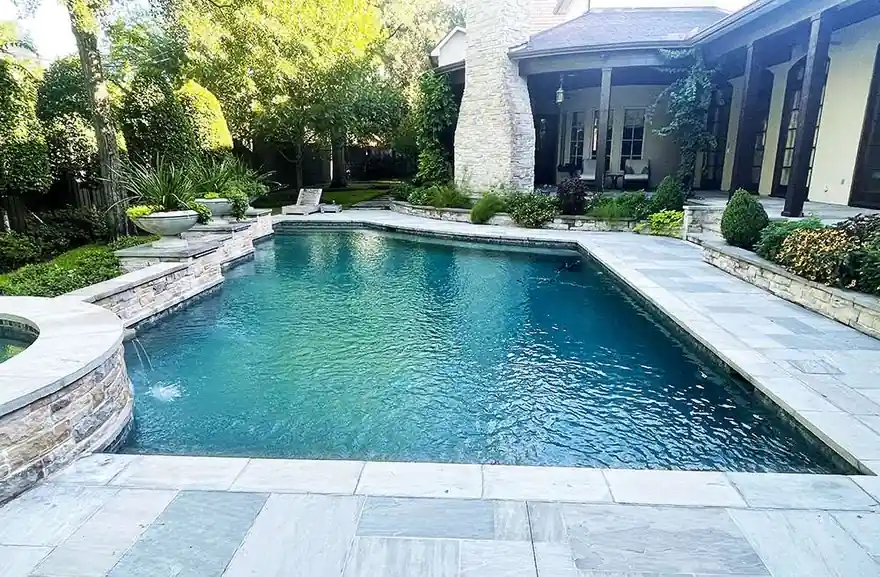
Walk the edge of almost any older Houston pool and you will find the same story written in small pieces: a hairline crack in a deck slab, a tile that sounds hollow, a band of coping that has lifted at a corner. None of it looks urgent. All of it is the pool telling you something about the ground it sits in and the weather it lives under. Sutton Pools' own view is that Houston's soils, climate and water chemistry create challenges that out-of-town contractors underestimate. This post explains what each one does to the parts of your pool you see every day.
Clay moves, and the pool does not
Much of the ground around Houston is expansive clay. It swells when it takes on water and shrinks and cracks when it dries. A pool shell is a rigid structure set into that ground, and the deck, the coping and the tile are all attached to or resting beside it. When the soil moves unevenly, the rigid parts move relative to one another. Rain after a dry spell, a dry stretch after a wet one, a sprinkler that over-waters one corner, a tree drawing moisture from another: each can shift the ground a little. A little is enough to open a joint.
The tile line takes the first hit
The waterline tile is where the pool wall meets the water surface, and it is exposed to everything at once. Water level rises and falls across it. Sunlight bakes it. Chemistry leaves scale on it. Movement in the shell loads the grout and the setting bed behind it.
- Loose or hollow-sounding tile. Tap it. A dull, flat sound where the neighbors ring suggests the bond has failed.
- Cracked or missing grout, which lets water in behind the tile.
- White, crusty scale along the line that brushing will not remove.
- Tile that has popped off entirely, leaving a bare patch of bond coat.
Water that gets behind failed tile does not stay put. It finds its way into the setting bed and the bond beam below, and it can make the next repair bigger than the first. It is worth dealing with at the stage when only a few tiles are involved.
Coping carries the heat
Coping is the cap that runs around the pool edge, covering the top of the wall and meeting the deck. In Houston, it spends the summer in direct sun, expanding in the afternoon and contracting at night. Over many cycles that repeated movement works the joints and the mortar beneath loose. Cracked or lifted coping is a trip hazard, and it lets water down behind the cap and into the structure.
Surface material matters here too. Dark or smooth coping can get very hot in direct sun and can become slippery when wet. When Sutton Pools replaces tile and coping, the materials are chosen to be slip-resistant and to handle the heat cycles that Houston pools go through.
Decks crack where the ground gives way
Deck slabs sit directly on the clay. When the soil under a slab settles, it can leave a void, and the slab cracks as it loses support. When the soil swells, it can push a section up and leave a lip at the joint. Either way, you end up with a surface that is uneven near water, where a stumble is more costly than it would be on a patio.
- Cracks wider than a hairline, especially where one side sits higher than the other.
- Slabs that sound hollow when you tap them or drop a heavy object.
- Water pooling on the deck instead of draining away from the pool.
- A gap opening between the deck and the coping where it used to be tight.
A cracked deck is not always a reason to pull it out. Many can be resurfaced or expanded with decorative concrete that handles the heat and looks good, provided the movement underneath has been addressed. Resurfacing over a slab that is still moving will only hide the crack for a while.
Water chemistry works on the edge too
Water that is out of balance leaves scale on tile and attacks grout and cement. Over time, that weakens the very joints that the soil and the sun are already working on. This is one reason steady water care is not only a matter of clear water. It protects the edge of the pool.
A seasonal walk-around
Once a season, walk the full perimeter slowly. Look at the tile line from the water side and the deck side. Tap suspect tile. Look along the coping from a low angle to catch lifted sections. Check that the deck drains away from the pool. Take photos, so next season you can see whether anything has changed. Small, stable cracks can be watched. Cracks that grow, tile that keeps loosening and decks that tilt should be looked at by someone who can tell the difference.
Sutton Pools' tile and coping replacement service, along with its pool deck renovation work, covers the edge of the pool in Houston and the surrounding area. Call (281) 789-4584 for a free, no-obligation quote.
Sutton Pools, (281) 789-4584
Call (281) 789-4584More articles
How to tell if your Houston pool is leaking
Every pool loses some water, so the real job is telling normal loss from a leak and knowing what a proper leak test involves.
Plaster, pebble or quartz: choosing a Houston pool finish
The finish is the part of your pool you touch, see and chemically stress every day, so the choice deserves more than a color swatch.